
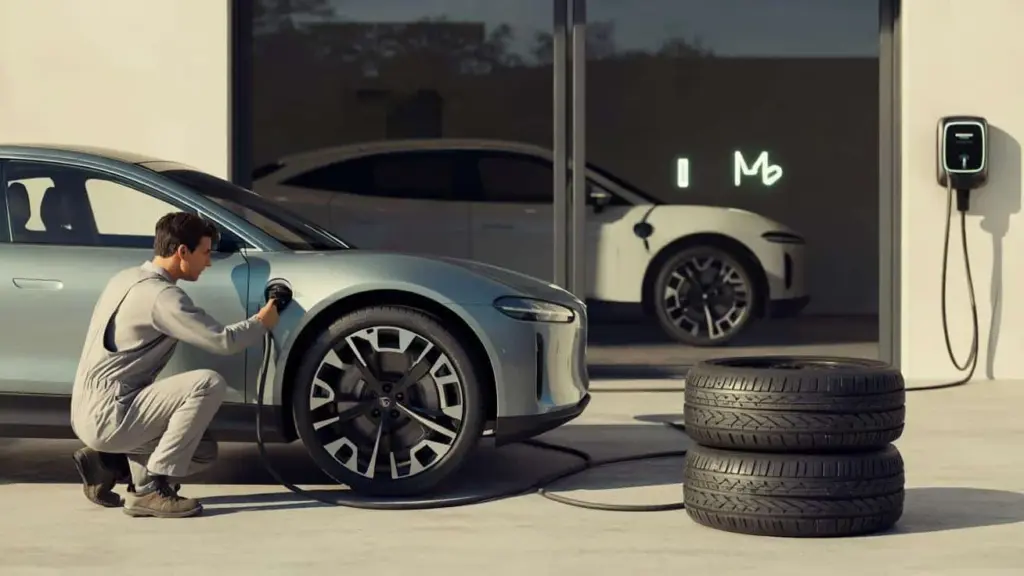
Drivers who switch to battery power usually focus on energy tariffs and charging apps, not rubber. Then the first set of worn tyres lands on the garage invoice, and the maths of going electric suddenly looks different.
Why electric cars eat through tyres faster
Electric vehicles are not just cleaner petrol cars with a battery. They behave differently on the road, and that has a direct impact on tyres.
Instant torque, instant wear
An electric motor delivers full torque the moment you touch the accelerator. There is no delay, no build-up. That instant shove feels addictive in city traffic and at junctions.
The downside sits at ground level. Each aggressive start sends a sharp load through the front tyres, biting into the asphalt. Over thousands of starts, that extra stress erodes rubber faster than the smoother torque curve of a petrol or diesel engine.
Fleet data suggests EV tyres can need changing around 10,000 km earlier than on equivalent petrol cars.
Even drivers who do not feel they are driving hard are still asking the tyres to manage more frequent bursts of maximum torque, especially in stop-start traffic where electric cars feel most at home.
Heavy batteries, heavier footprint
The other big difference is weight. Batteries add hundreds of kilos to a car. A small electric hatchback can easily weigh 300–400 kg more than its petrol sibling.
That extra mass presses constantly onto the contact patch – the palm-sized area of rubber touching the road. Every time the car accelerates, brakes or turns, the tyres carry more load and flex more intensely.
On urban routes, with regular speed bumps, roundabouts and tight corners, this additional weight punishes tyres. The tread heats up, deforms and sheds tiny fragments more quickly, shortening life between replacements.
➡️ Savoyards never cook crozets in water – and their secret makes the dish perfect
➡️ Schlechte nachrichten für einen rentner der einem imker land verpachtet hat er muss landwirtschaftssteuer zahlen fühlt sich vom staat verraten und bringt sogar freunde und familie gegeneinander auf
➡️ Lang: Schlechte Nachrichten für Mieter mit ölheizung die ihre nebenkosten senken wollen sie halbieren mit einem simplen trick ihre energiekosten und ruinieren gleichzeitig die klimapolitik ihres mietshauses was ihre nachbarn in zwei verfeindete lager spaltet
➡️ Wet seeds kill birds in winter: the mistake almost every gardener makes
➡️ Another €1.4 Billion Mega-Deal For France’s Safran Cements Its Lead In The Aircraft Engine Market With The LEAP-1A
➡️ Warum man die Schnittkante von Käse mit etwas Butter einreiben sollte, um Austrocknen und Schimmel im Kühlschrank zu verhindern
➡️ Wie Verfassungsänderungen sich ändernde gesellschaftliche Werte und politische Prioritäten über Zeit widerspiegeln
➡️ Acht Strategien, altes Tech in smarte Home-Hubs upzuzyklen, ohne Neukäufe
Electric cars combine heavy weight with sharp acceleration – a perfect recipe for faster, more expensive tyre wear.
Special EV tyres: what you’re really paying for
Tyre makers have not simply reused existing designs. Modern EVs arrive on bespoke tyres engineered for their specific demands.
Less rolling resistance, more rigidity
To preserve driving range, EV tyres focus on low rolling resistance. The rubber compound, tread pattern and internal structure are tuned so the tyre glides more easily on the road.
At the same time, manufacturers stiffen the carcass to handle extra weight and brutal torque without deforming too much. That rigidity supports better handling, yet it must not spoil comfort.
This tight engineering brief means a more complex construction, more research and often more expensive materials.
Quieter by design
Without engine noise, every hum and roar from the tyres becomes more obvious inside an EV cabin. To keep the car feeling refined, suppliers work hard on noise reduction.
Some brands line the inside of the tyre with foam to absorb resonance. Others sculpt tread blocks specifically to cut the “whine” you hear on concrete motorways.
Instead of the engine masking tyre roar, the tyres themselves are now tasked with being quieter.
These tricks add cost. Studies from European consumer outlets suggest that swapping four EV-specific tyres can average around €240 more than a comparable set for a petrol car – and that gap stings more if you replace tyres more often.
How the costs stack up against charging
One reason this topic creates such a reaction is the comparison point: charging an EV is often relatively cheap, especially at home.
In many European countries, fuelling an EV for 10,000 miles a year can cost far less than buying petrol or diesel. But tyres are a separate line on the budget sheet, and they hit in big chunks instead of small weekly payments.
| Item | Typical EV cost | Typical petrol car cost |
|---|---|---|
| Energy / fuel for 10,000 miles (home charging vs fuel) | Lower | Higher |
| Tyre lifespan | Shorter (by ~10,000 km in many cases) | Longer |
| Price per full set of tyres | Higher | Lower |
For a typical driver keeping a car three or four years, that can mean one extra tyre change, at a higher unit price. The annualised cost may still be modest compared to fuel savings, but it dents the narrative of EVs being maintenance-free.
How driving style can cut your EV tyre bill
The way you drive affects tyres just as much as the car’s hardware.
Habits that shorten tyre life
- Hard launches from traffic lights that spin or chirp the front tyres.
- Late, sharp braking that heats the tread and scrubs off rubber.
- Cornering faster than necessary on roundabouts and slip roads.
- Neglecting tyre pressure checks, leading to underinflated tyres that overheat.
Electric cars make some of these behaviours more tempting. Instant response and quiet acceleration invite brisk take-offs. Regenerative braking may give the feeling that the car is under control, even when deceleration is strong.
Simple changes that really work
Drivers who adjust their habits can slow wear noticeably. The most effective moves are straightforward:
Many EV owners report gaining several thousand extra kilometres from a set of tyres simply by softening their right foot.
Choosing the right tyres for your EV
The replacement choice also shifts the long-term cost equation.
Premium EV tyres vs mid-range options
Top-tier EV tyres promise maximum range, low noise and crisp handling, but their list price can shock new owners.
Mid-range models, often labelled as “EV ready” or tuned for efficiency, try to balance performance and price. They may give up a few miles of range or a few decibels of quiet but still meet safety standards.
Key factors to compare when buying:
- Rolling resistance rating (affects range and energy use).
- Wet grip rating (shorter stopping distances in the rain).
- Noise rating in decibels (cabin comfort on motorways).
- Load index (must match or exceed the heavier EV specification).
Sticking to the correct load rating is non-negotiable on a heavy EV. A cheaper tyre that cannot cope with the weight risks overheating and failure.
What tyre wear means for the bigger EV picture
Tyres are also part of a wider environmental conversation. Heavier vehicles shed more rubber particles, contributing to microplastic pollution. Faster wear on EVs intensifies that concern.
Manufacturers are responding with new compounds, alternative materials and tyres designed to last longer without raising rolling resistance. There is a trade-off between durability, grip, noise and efficiency, and the “perfect” EV tyre does not exist yet.
For buyers, this means tyre technology will keep evolving during the life of their car. A replacement set in three years’ time may behave quite differently from the original equipment, and price trends could continue upward as more sophisticated designs hit the market.
Practical scenarios: what an owner can expect
Take a typical suburban driver covering 12,000 miles a year in a compact EV. With the original tyres, they may face replacement at around 18–22 months instead of the two-and-a-half years they were used to in a petrol hatchback.
They could then choose a slightly cheaper mid-range EV tyre, accept a tiny hit on range, and pair that with gentler driving. Over a three-year lease, this might turn two expensive tyre changes into one premium replacement and one cheaper set, cutting the bill significantly.
On the other hand, a company car driven briskly on motorways, with little attention to tyre pressures, could burn through front tyres annually. In that case, the tyre budget begins to rival, or even exceed, the cost of home charging for the same distance.
Key terms worth unpacking
Rolling resistance is the effort needed to keep a tyre moving at constant speed. Lower resistance means the motor uses less energy, which extends range. Yet ultra-low resistance can sometimes lengthen braking distances if not balanced with enough grip.
Regenerative braking uses the electric motor to slow the car and recover energy. It reduces wear on brake pads and discs, but the weight shift to the front wheels during deceleration still loads the front tyres heavily.
Load index is the code on the tyre sidewall indicating how much weight it can carry safely. EVs often need higher load indexes than visually similar petrol cars, which narrows the range of suitable tyres and nudges prices up.
For many EV owners, the “hidden” running cost is no longer fuel, but the four contact patches that make all that quiet power usable.