
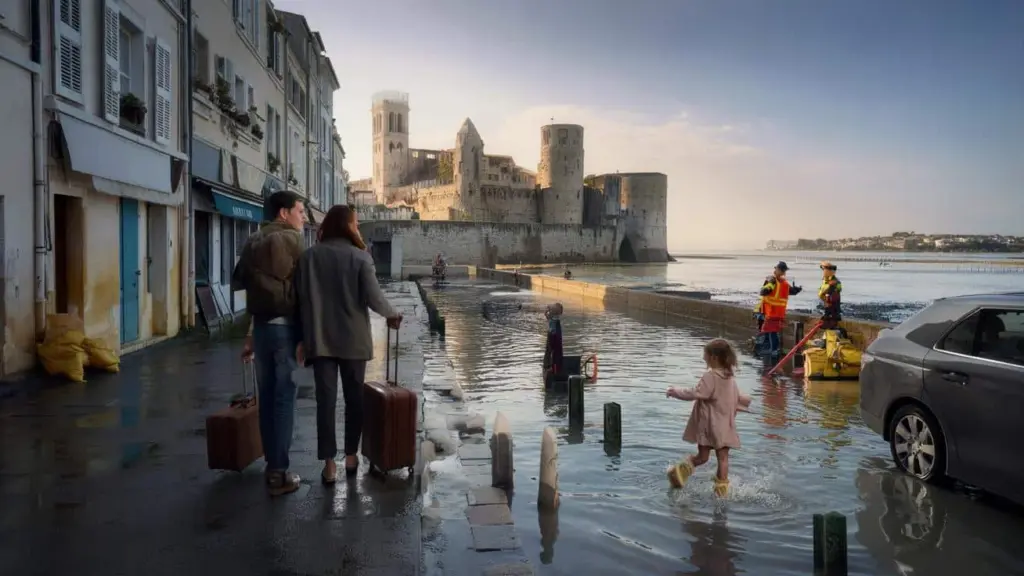
Across France’s most coveted coastal spots, the postcard image hides a sharp deadline. Rising seas, tired sea walls and nervous insurers are already reshaping daily life, and by 2030 some districts could feel less like a calm retreat and more like a long emergency.
From holiday fantasy to high-tide headache
Climate projections that once aimed at 2050 are now catching up with the 2030s. The Atlantic and Mediterranean coasts are feeling it first. Higher sea levels amplify storm surges, chew away beaches and quietly push saltwater into the ground beneath homes.
What looks like a once-in-a-century flood today could, by 2030, become a regular feature of spring tides.
The science is fairly clear: warmer oceans expand, polar ice melts, and the total volume of water pressing against Europe’s shores keeps increasing. The complication for residents is that the change isn’t just about dramatic storms. It’s the water that does not fully recede, the damp cellar that never quite dries, the road that becomes impassable twice a month.
La Rochelle: a historic harbour living on borrowed time
La Rochelle, on France’s Atlantic coast, normally appears in British travel supplements as a dreamy weekend escape. By 2030, living there could feel very different if you own property near the old harbour or in low-lying streets.
The city sits barely above sea level in many areas. That charming Vieux-Port, with its medieval towers and café terraces, is particularly exposed. On the highest tides, waves already lick the top of quaysides. Add another few centimetres of sea level and more frequent winter storms, and regular saltwater flooding becomes likely.
Future residents may plan school runs and commutes around tide tables, not just traffic reports.
For homeowners, that means more than wet feet. Salty moisture attacks stone and concrete, weakens building foundations and corrodes underground pipes. Rebuilding or raising quays, installing pumps and redesigning drainage would require huge investment, and there is a real question over who pays: local councils, the state or private owners.
The fragile lifeline of the Île de Ré
Just across the water from La Rochelle, the Île de Ré faces a different kind of risk. The island is already narrow at several points. Some strips of land are only a few hundred metres across, flanked by the ocean on one side and wetlands on the other.
➡️ Your TV’s USB port isn’t useless: 4 smart ways to actually use it
➡️ Shein, Temu, Aliexpress: why you’ll now pay more for all your orders from Chinese platforms
One of the most sensitive zones is the Martray isthmus, the thin section linking the two main parts of the island. Strong storms and high tides are gradually wearing it down. If repeated flooding cuts this stretch too often, or if a breach opens during a violent winter event, the island could be effectively split.
For residents, that scenario means longer routes for ambulances, harder access for deliveries, and far more complicated evacuations. Romantic isolation rapidly turns into a logistics challenge when every storm threatens to close the only practical route.
Arcachon and Cap Ferret: when the view becomes a liability
Further south, the Arcachon basin is already a live demonstration of coastal erosion. Sandbanks shift, channels move, and each winter the Atlantic strips away more of the dunes that protect houses at Cap Ferret and surrounding communities.
Owning “beachfront” property here can mean watching the beach itself disappear, metre by metre.
Several neighbourhoods that once felt comfortably set back from the sea now sit uncomfortably close to the edge. Protecting them demands constant work: new groynes, emergency rock walls, periodic sand replenishment. Those interventions buy time, but they rarely offer permanent security.
By 2030, living in these areas could involve accepting that your property might be reclassified as at risk of collapse, or that public authorities decide to abandon defence of some stretches altogether. For buyers, a panoramic ocean view increasingly comes with a serious question: how long will the land beneath it last?
Camargue and Aigues-Mortes: below sea level, above the danger line
On the Mediterranean side, the Camargue and the surroundings of Aigues-Mortes face a quieter, but equally serious threat. Much of this region sits at or below current sea level. Its survival depends on a network of dykes, sluice gates and pumps that hold back saltwater and keep fields and villages dry.
This kind of landscape behaves more like the Netherlands than a typical French coast. As sea level rises, pressure on the defences grows, and water finds new paths through the soil. Salty intrusion into groundwater can damage rice fields, vineyards and wetlands, threatening both local incomes and the delicate mix of wildlife that draws visitors.
Life here may soon mean relying on complex water engineering, with failure measured not in puddles but in permanent loss of farmland.
If floods become more frequent, maintaining or upgrading those systems will be extremely costly. Historical sites such as the ramparts of Aigues-Mortes could end up standing in brackish water more often, which brings structural risks and complicated restoration work.
Vendée and Loire-Atlantique: living behind the dyke
Parts of Vendée and Loire-Atlantique were literally won from the sea centuries ago. Marshes were drained and protected with dykes, creating low-lying land known as polders. Many residents live with the memory of storm Xynthia in 2010, when sea defences failed and several communities flooded with tragic consequences.
Since then, France has toughened building rules and inspected its dykes more rigorously. Even so, a higher baseline sea level makes every future storm riskier. The same wave that once just topped a dyke may, by 2030, push significantly further inland.
- Noirmoutier: island linked by a causeway at low tide, with housing clusters close to sea level
- Baie de l’Aiguillon: vast flat area protected mainly by long stretches of dyke
- Low-lying suburbs near estuaries: vulnerable to combined river floods and storm surges
Local planners have started using a phrase that will shape many coastal lives: “strategic retreat”. It describes deliberately abandoning the most exposed zones rather than endlessly rebuilding at the same place. For some residents, that could mean compulsory purchase or being told that rebuilding after a flood is no longer allowed.
Property and insurance: when your asset turns into a risk
For many British and European buyers, a home on the French coast has long been both an emotional dream and a financial plan. Increasingly, that equation is changing. Banks, insurers and notaries are factoring climate risk into their decisions, sometimes more strictly than public debate suggests.
An address that once guaranteed resale value may, by the end of the decade, be treated as a stranded asset.
Real estate agents in some coastal communes already report slower sales and sharper price cuts for homes in the lowest streets or right behind sea walls. Even without dramatic flooding, rumours of future risk can drain enthusiasm from the market. Buyers negotiate harder, lenders ask more questions, and transactions take longer.
Insurance is the next pressure point. French home policies are partly backed by a national natural-disaster scheme, but private insurers can raise premiums or adjust conditions. In zones repeatedly hit by floods or classified as highly exposed, owners may face sharply higher deductibles, strict requirements for protective works, or simple refusal of cover for certain risks.
Thinking of moving there by 2030? What you need to check now
If you are considering a move to the French coast in the next few years, the checklist needs updating. Sea views and terrace sizes still matter, but the ground level beneath your feet should now be part of the conversation.
| Aspect | Questions to ask before buying |
|---|---|
| Elevation | How many metres above current sea level is the property, and is it in a known floodplain? |
| History | Has the area flooded in the last 20–30 years, and how often do roads nearby close in storms? |
| Defences | Is the home behind a dyke or sea wall, and who is responsible for maintaining that structure? |
| Insurance | Are insurers imposing special conditions, higher deductibles or exclusions for marine submersion? |
| Local plans | Does the town have a managed-retreat policy or zones where rebuilding might be restricted? |
Speaking to local residents can be unusually valuable here. They know which roads flood first, which cellars smell of salt, and how serious the last “big one” really felt. Estate agents may underplay those details, while long-term neighbours rarely do.
Why 2030 feels closer than it sounds
Climate models talk in decades, but mortgages and renovation plans are also long-term commitments. A buyer in 2026 signing a 20-year loan is effectively betting on conditions in the mid-2040s. Authorities, on the other hand, are starting to work with roadmaps that include relocation, higher taxes for exposed areas and strict new building bans.
That mismatch can create nasty surprises. A home that seems safe at the survey stage could fall into a newly defined red zone during the life of the mortgage. That might restrict extensions, complicate resale or lead to loss of value as buyers shy away. Understanding the local planning maps, especially hazard zoning, is becoming as critical as checking broadband speeds.
Beyond the headlines: what “submersion risk” really means day to day
For anyone not used to coastal jargon, some terms can sound abstract. “Submersion marine” in French planning documents, for instance, refers not only to dramatic waves over sea walls but also to slow, repeated overtopping that leaves standing water behind. Even a few centimetres inside a house several times a year can be enough to damage floors, wiring and insulation.
Salinisation is another quiet threat. When saltwater seeps into groundwater, it can corrode metal, ruin pipes and weaken concrete. Gardens die back, wells become unusable, and damp problems multiply. None of this makes front-page news, yet it shapes how liveable a place feels in daily life.
One practical scenario to keep in mind: a family buys a holiday home in a charming low street, two blocks from the sea. In 2028, a new hazard map classifies the area as flood-prone. By 2030, their insurer raises premiums sharply and demands that electrical sockets be moved higher and doors be fitted with flood barriers. Resale interest drops. The house is still standing, the sunsets are still beautiful, but the practical and financial effort of keeping it becomes far bigger than they expected.
Coastal France will not vanish by 2030, and many areas remain relatively secure for decades. Yet the comfortable assumption that a sea-facing address is always a safe bet is fading. For anyone tempted by a move to La Rochelle, Île de Ré, Arcachon, the Camargue or the polders of Vendée and Loire-Atlantique, the smarter approach now is simple: pair the dream with a due-diligence file thick with flood maps, insurance quotes and hard questions about how often the pavements already get wet.