
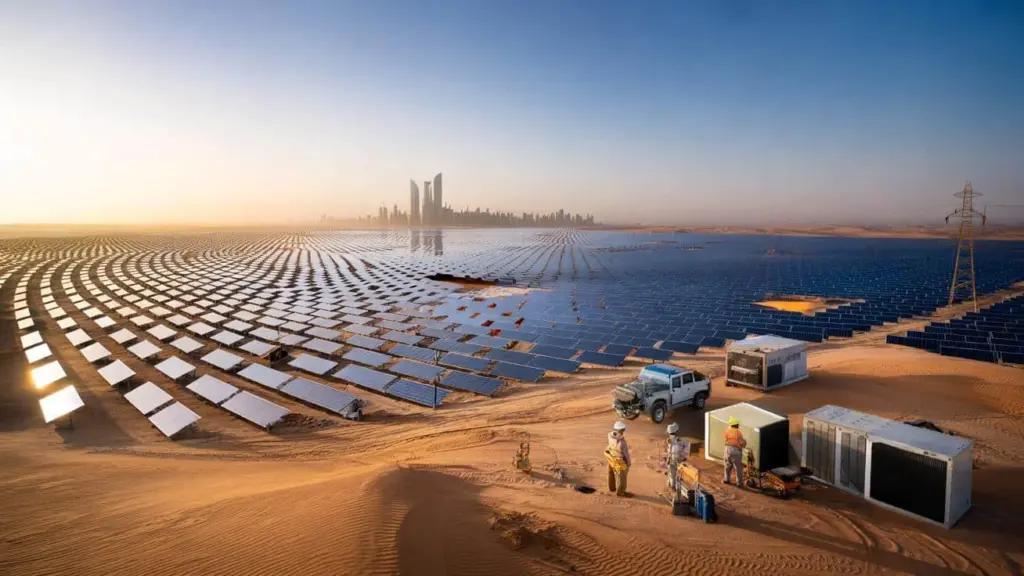
Far from the skyscrapers and shopping malls, engineers are racing to build a solar complex so large it has been nicknamed an “artificial sun”, designed to beam clean power into Emirati cities around the clock.
A solar giant rising in the sand
The project, called Khazna Solar PV, is now under construction in the United Arab Emirates on a site of about 90 square kilometres in the Abu Dhabi desert.
It is being developed by Masdar, French energy group Engie, and Emirates Water and Electricity Company (EWEC), three major players betting heavily on large-scale clean power.
Once completed, Khazna Solar PV is expected to deliver 1.5 gigawatts (GW) of low‑carbon electricity continuously, 24 hours a day, seven days a week.
Engineers aim to provide steady solar power at a scale no existing plant has yet achieved, effectively mimicking the reliability of a conventional power station.
The target for full operation is 2027, putting the UAE among the countries pushing hardest to shift their power mix away from gas and oil, even as they remain major fossil fuel exporters.
Three million panels forming an “artificial sun”
Khazna’s most striking feature is the sheer number of solar panels: around 3 million photovoltaic modules will be installed across the desert site.
Each panel converts sunlight into electricity, but it is the combined effect that matters. Together, they will feed power into a system designed to keep electricity flowing even when the sun is not shining.
According to project estimates, the plant will be able to power around 160,000 homes in the Emirates once fully operational.
➡️ Wenn der klimakleber vor ihrem auto steht pendler im stau polizei im dauereinsatz eine geschichte die die republik spaltet
➡️ Wölfe im land fluch für bauern segen für naturschützer
➡️ With this ship, China could gain a head start in ocean exploration
➡️ Stronger than Starlink: stratospheric internet could extend connectivity across the entire planet
➡️ Rentner verweigert steuern für imkerland und spaltet das halbe dorf
➡️ “I make it every Sunday in winter”: the potato and Brussels sprout bake that won over my whole family
➡️ Rentner soll landwirtschaftssteuer zahlen weil er seine wiese an einen imker verpachtet hat und jetzt leer ausgeht
➡️ Der lehrer der seine schüler nach noten ordnet und eine schule in ein lager aus gewinnern und verlierern verwandelt
By replacing fossil‑fuel generation, Khazna could prevent more than 2.4 million tonnes of CO₂ emissions every year — roughly equal to taking about 470,000 petrol cars off the roads.
This kind of climate benefit is central to the UAE’s strategy to present itself as a regional hub for clean energy, while still exporting hydrocarbons.
How can solar run 24/7?
Solar panels alone only produce electricity when the sun is up. To keep power flowing through the night, Khazna relies on a combination of technologies and grid strategies.
Advanced tracking and smart control
All panels will be fitted with “solar tracking” systems. These are motorised mounts that automatically adjust the angle of the panels during the day, following the path of the sun.
That simple movement matters. By facing the sun more directly, panels generate more electricity in the early morning and late afternoon, stretching output beyond the midday peak.
Solar tracking can increase energy yield by a significant margin, squeezing more electricity out of the same plot of land.
The plant will also rely on advanced digital tools to manage power output. Sensors and software will constantly monitor sunlight, temperatures, and equipment performance, adjusting how the whole system operates.
Storage and grid balancing
Continuous power requires storage and sophisticated grid planning. While detailed technical designs have not been fully public, projects on this scale usually combine several approaches:
- Battery energy storage to hold excess power from midday and release it in the evening and at night.
- Agreements with other power plants to provide backup during rare cloudy periods or outages.
- Grid management tools that smooth fluctuations and keep frequency and voltage stable.
The idea is not that the sun shines at midnight, but that the system captures and shifts enough daytime power to keep a steady flow available at any hour.
A flagship for the UAE’s energy transition
The UAE has long relied on oil and gas, both for export and domestic power generation. Projects like Khazna signal a calculated shift.
Abu Dhabi already hosts one of the world’s largest single‑site solar projects, and Khazna raises the stakes again, combining massive capacity with round‑the‑clock availability.
For the Emirates, the benefits are multiple:
| Aspect | Expected impact |
|---|---|
| Energy security | Less dependence on gas‑fired plants for domestic electricity |
| Climate policy | Significant reduction in power‑sector emissions |
| Economy | New industrial activity, engineering jobs and technology transfer |
| Global image | Positioning as a regional leader in large‑scale renewables |
For residents, the shift is largely invisible: lights remain on, air conditioning still runs, but an increasing share of that power no longer depends on burning fuels.
Digital desert: high‑tech tools behind the panels
The site will use a suite of digital solutions to keep the plant operating efficiently in harsh desert conditions.
Heat, dust and sandstorms can quickly degrade performance if not managed properly. Sensors on panels and inverters will help detect issues early, allowing targeted cleaning and maintenance.
Machine‑learning tools are expected to forecast solar output based on weather and historical performance, so grid operators can plan ahead and avoid surprises.
In a plant this large, even a small percentage gain in efficiency translates into power for thousands of homes.
Remote monitoring rooms, often hundreds of kilometres away, will watch over the plant in real time, adjusting settings and dispatching crews when needed.
What “1.5 gigawatts” really means
Energy figures can feel abstract. A gigawatt is one billion watts, roughly the capacity of a large nuclear reactor or several big gas‑fired units.
At 1.5 GW, Khazna’s peak power will rival or exceed many national grids in smaller countries. Of course, actual daily energy production depends on sunshine hours and how the storage systems are configured.
Over a typical year in the Middle East’s sunny climate, a plant like this can generate several billion kilowatt‑hours of electricity. That is enough to make a visible dent in a country’s carbon footprint.
Why deserts are prime locations for “artificial suns”
Deserts offer near‑ideal conditions for solar: clear skies, high irradiation, and vast open land far from dense housing.
The flip side is the challenge of distance. Power must be transmitted over long lines to reach cities, and infrastructure must withstand heat and sand.
Despite these hurdles, desert solar is being pushed across the Middle East, North Africa, the US Southwest, Australia and parts of India.
Khazna belongs to a new generation of mega‑projects that treat deserts as strategic energy assets rather than empty land.
Key terms worth unpacking
What is photovoltaic solar?
Photovoltaic (PV) panels are made of semiconductor materials, most often silicon. When sunlight hits them, it frees electrons, creating an electric current.
Unlike concentrated solar power, which uses mirrors and heat, PV systems generate electricity directly in the panels and feed it into inverters and then the grid.
What does “decarbonised electricity” mean?
The term refers to power generated with very low greenhouse gas emissions across its life cycle.
Solar panels do have a carbon footprint, mainly from manufacturing and transport, but it is far lower than that of coal, oil or gas plants once spread over decades of operation.
Risks, challenges and what could go wrong
Even the most carefully planned mega‑project faces hurdles.
Dust accumulation can cut panel output sharply, meaning cleaning schedules and water use must be carefully managed in an already arid region.
Battery storage, if deployed at large scale, raises questions of cost, raw materials, recycling and fire safety. Grid operators also need reliable backup plans for rare but possible extended cloudy periods.
There are economic risks as well. If technology prices fall faster than expected, an early project may end up looking expensive compared with later plants using newer equipment.
What this could mean for other countries
Khazna will act as a real‑life test case for running large cities on solar‑heavy grids while keeping power firm and predictable.
Countries with big desert or semi‑arid regions — from Saudi Arabia to Egypt, from Australia to parts of the US — are watching closely. If the “artificial sun” approach proves reliable and cost‑effective, similar hybrid solar‑plus‑storage complexes could appear in many more regions.
For households and businesses, the shift often starts with visible rooftop panels. Projects like Khazna show what happens at the other end of the scale: entire landscapes turned into quiet, humming power stations, designed to catch every ray and keep the grid humming long after sunset.