
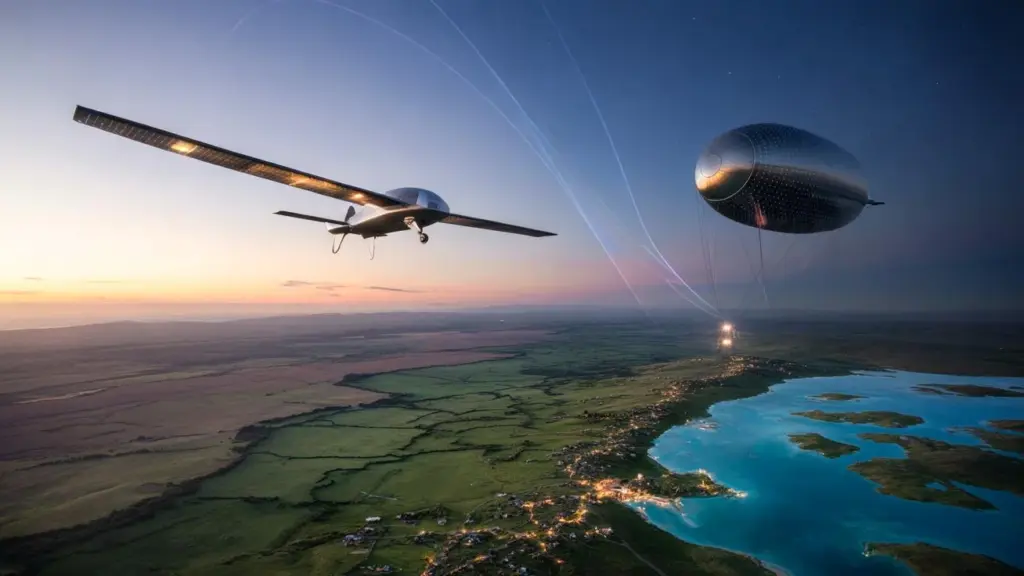
Now a new generation of solar aircraft quietly promises a different way to connect.
While satellite constellations grab headlines, telecoms firms and aerospace start-ups are racing to occupy a forgotten layer of the sky: the stratosphere. From this high, calm zone, fleets of robot aircraft and airships could beam cheap, fast internet to almost any corner of Earth.
Why space internet alone is not enough
In 2026, tens of thousands of low‑Earth orbit satellites will be circling above us, led by Starlink and OneWeb. Yet, according to the UN’s International Telecommunication Union, around a quarter of humanity will still have no usable internet connection. That is roughly 2.2 billion people, mostly in rural or remote regions.
Satellite systems face three key limits.
- Shared bandwidth: when too many users connect in the same area, capacity per person collapses.
- Complex networks: true global coverage needs full constellations in low orbit, which are costly to build, launch and maintain.
- High prices: satellite antennas, subscriptions and power needs remain out of reach for many households in developing countries.
For large parts of Africa, Asia and Latin America, running fibre across mountains, jungle or desert is uneconomic. Traditional mobile towers often make little business sense where population density is low. That leaves vast “not spots” where schools, clinics and small businesses are effectively offline.
Stratospheric platforms aim to sit halfway between ground masts and orbital satellites, cutting costs while keeping speeds high.
How stratospheric internet actually works
The technology centres on HAPS, or High Altitude Platform Stations. These are long‑endurance aircraft that loiter at around 18 to 25 kilometres above the surface, far above commercial air traffic, but far below satellites at roughly 500 kilometres or more.
A HAPS can be:
- a helium‑filled airship or dirigible
- a very light solar‑powered drone with long, thin wings
- a balloon or other unmanned aircraft designed for ultra‑long flights
Solar panels across the wings or hull charge batteries during the day, allowing the platform to stay aloft for weeks or even months. From that vantage point it carries telecoms equipment, effectively acting as a mobile tower in the sky, serving an area the size of a small country.
Because the signal only travels a few dozen kilometres up and down, latency stays low, closer to 4G or early 5G performance than to traditional satellite links. Shorter distances also mean less power per connection and more efficient use of radio spectrum.
➡️ Warum du trotz guter vorsätze im januar scheitern wirst weil du dich morgens an eine kleine lüge klammerst die deinen fokus und deine motivation langsam zerstört
➡️ Unter 40 Euro: Dieses Lidl-Gerät ersetzt Heißluftfritteuse und Backofen in einem einzigen kompakten Küchenhelfer
➡️ Wie sie mit einem essensplan ihre ausgaben für lebensmittel senken und verschwendung vermeiden
➡️ Schlechte nachrichten für kollegen wenn teilzeit jobber jahre später geld für alte überstunden verlangen und damit firmen in schieflage bringen
➡️ Why China’s high-speed rail is now pulling ahead of the French model
➡️ Eine junge Frau teilt, wie sie mit Natron den Kühlschrank reinigt und Gerüche neutralisiert
➡️ The Chinese J-36 stealth fighter tests a key technology for modern naval warfare
➡️ Dieses angeblich revolutionäre deutsche klimagesetz enteignet heimliche heizsünder während millionäre mit luxusvillen weiter ungestört fossile energie verschwenden und die politik sich dafür feiern lässt
One HAPS can cover hundreds of thousands of square kilometres, bringing high‑speed, low‑latency links to places where fibre and towers do not pay off.
From failed balloons to serious contenders
The idea is not new. Experiments with high‑altitude platforms go back to the 1990s. Alphabet’s Loon project, launched in 2011, floated giant balloons around the globe, aiming to beam 4G coverage to remote customers. Loon managed impressive technical feats, but the business case collapsed and the project closed in 2021.
Loon faced several obstacles: keeping balloons roughly above the same region, dealing with winds, and managing the logistics of launching and recovering short‑lived hardware. At the same time, satellite constellations were scaling up and costs were falling, making balloons look less attractive.
Today’s efforts take those lessons seriously. Rather than drifting, new platforms are designed to hold position precisely for long periods. They borrow technologies from both aviation and satellites: ultra‑efficient solar cells, lightweight composite structures, and advanced autopilot systems.
Key players racing to occupy the stratosphere
Sceye: solar dirigibles over the Americas
US start‑up Sceye is building a 65‑metre solar airship filled with helium. The company aims to hover these platforms over targeted regions, offering what amounts to a stratospheric mobile mast.
The key selling points are long endurance and stability. By holding its position tightly over a given area, a single dirigible could serve cities, rural communities and major roads simultaneously, while avoiding the huge infrastructure bill of thousands of ground towers.
Aalto HAPS and the Zephyr drone
Aalto HAPS, an Airbus spin‑off, is betting on fixed‑wing solar drones rather than airships. Its flagship, Zephyr, has a wingspan of about 25 metres, but weighs less than many motorbikes. In testing, Zephyr has stayed in the air over the same general area for 67 days straight.
That kind of persistence hints at a new class of telecoms infrastructure: aircraft that behave more like reusable satellites than like planes. Once launched, they could operate for months with minimal human intervention, automatically tracking weather and sun angles to maximise power and coverage.
World Mobile and hydrogen‑powered coverage
UK‑based World Mobile is developing a hydrogen‑powered drone intended to provide around 200 megabits per second of bandwidth. The company focuses heavily on real‑world economics.
Its figures suggest that just nine such platforms could cover the 5.5 million residents of Scotland. On their model, the cost per person would be around £0.80 a month, dramatically lower than a typical Starlink subscription at roughly £75 per month in the UK.
Early economic models suggest stratospheric networks could slash the cost of rural connectivity, especially in sparsely populated regions.
How stratospheric and satellite networks can work together
Stratospheric internet is not designed to replace satellites outright. Instead, it fills gaps and adds capacity where satellite bandwidth is tight or ground infrastructure is missing.
A typical network could combine:
| Layer | Main role | Strength |
|---|---|---|
| Ground fibre & 5G | Cities and dense suburbs | Very high speed, reliable backhaul |
| Stratospheric HAPS | Rural regions, islands, disaster zones | Lower cost coverage, low latency, flexible deployment |
| Satellites | Oceans, polar areas, global backbone | Truly global reach, long‑distance links |
In an emergency, such as an earthquake or major flood, a HAPS could be flown quickly over the affected region, restoring mobile and internet services when towers are down and roads are blocked. Satellites would handle long‑distance backhaul, while HAPS manage local links to phones and Wi‑Fi hotspots.
The regulatory and spectrum challenge
The path to large‑scale deployment does not just depend on engineers. National regulators and international bodies must agree how HAPS share radio spectrum with existing mobile operators, satellite systems and aviation services.
Questions still open include: what frequencies can these platforms use, who controls them over international borders, and how traffic should be routed between sky‑based nodes and ground networks without congestion.
Telecoms companies see potential in leasing capacity from HAPS operators rather than building expensive towers in difficult terrain. Yet they also want clear rules on liability, safety and long‑term access to spectrum before committing serious money.
What “bandwidth”, “latency” and “throughput” really mean
Much of the promise of stratospheric internet rests on familiar technical terms that often get blurred together.
- Bandwidth is the maximum rate at which data can move through a connection, usually measured in megabits per second (Mb/s) or gigabits per second (Gb/s).
- Latency is the delay between sending a request and getting a response, measured in milliseconds. Long distances, such as to satellites, raise latency.
- Throughput is what users actually experience at a given moment, which depends on bandwidth, congestion and network design.
HAPS aim to keep latency relatively low by cutting the physical distance the signal must travel, while using focused beams and advanced radio techniques to preserve bandwidth over large areas.
Concrete scenarios: from Scottish glens to African savannas
Imagine a small island community currently relying on a single copper line and patchy 3G. A stratospheric drone could loiter above the region, offering 4G‑like speeds to homes and fishing boats, with backhaul via satellite or a single undersea fibre link. The local operator would avoid building dozens of towers that could corrode in salty air and storms.
In sub‑Saharan Africa, where villages may sit tens of kilometres apart, a HAPS could beam coverage across farms, roads and markets in one footprint. Schools equipped with simple Wi‑Fi routers and solar panels could tap into online textbooks and remote teaching. Clinics could send scans and lab results to regional hospitals within seconds.
For richer countries, HAPS might be used to strengthen coverage along motorways, rail corridors and national parks, where building and maintaining towers is disruptive or expensive. They could also act as backup networks during power cuts or cyber incidents affecting ground infrastructure.
Risks, constraints and what could go wrong
There are still serious unknowns. Stratospheric winds can be fierce and hard to forecast, even if they are more stable than lower‑altitude weather. Keeping an aircraft in exactly the right spot for months is a non‑trivial control problem.
There are also safety and security concerns. Aircraft and airships need rigorous certification so they do not pose a risk if they fail. Cybersecurity becomes critical, as each platform functions as a major node in the global internet. A successful attack could disrupt connectivity over an entire region.
Economic sustainability is another question. Loon’s experience showed that technical success does not guarantee commercial viability. Operators will need long‑term contracts, probably with mobile carriers and governments, to keep aircraft in the sky year‑round.
What this could mean for everyday users
If the technology matures, people may never notice they are connected via the stratosphere. Phones will still show 4G or 5G. Routers will still blink in the corner of the room. The difference will be that coverage maps finally include mountain villages, fishing harbours and inland farms that have been ignored for decades.
For those already connected, HAPS could bring more competition to remote broadband markets, driving down subscription prices. For the 2.2 billion people still offline, these silent, solar‑powered aircraft might be their first real gateway to online banking, education, healthcare and global trade.