
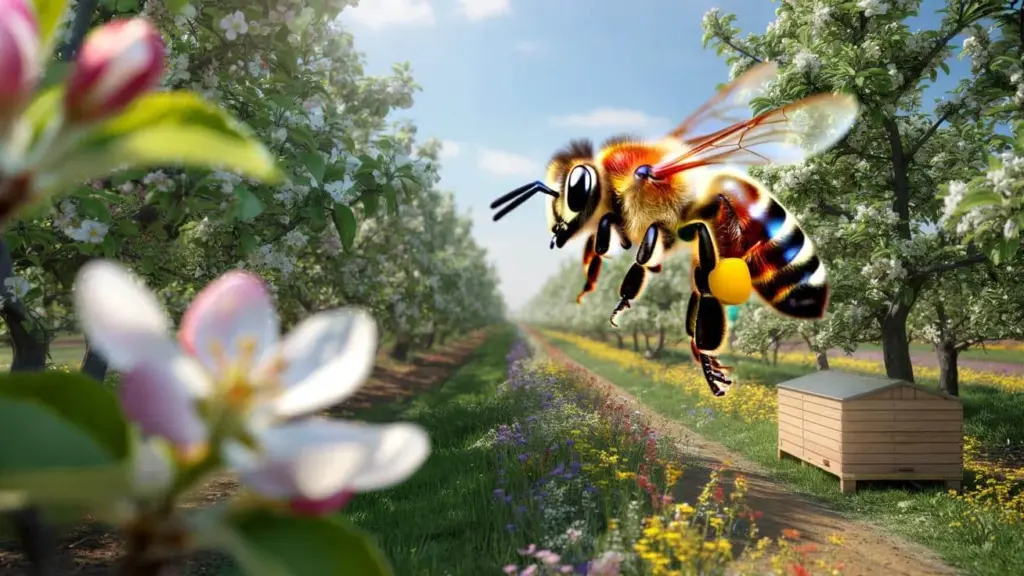
As traditional treatments lose ground against bee diseases and crop blights, scientists are turning to an unexpected ally hidden in plain sight: the living microbes tucked inside every grain of pollen.
A quiet crisis in the hive
Bee colonies around the world face a barrage of viruses, bacteria, fungi and parasites. Researchers have already identified more than 30 different pathogens in hives. Many of them target larvae, silently weakening colonies that farmers rely on to pollinate fruit trees, vegetables and oilseed crops.
Standard tools against these infections are struggling. Antibiotics used in beekeeping, such as oxytetracycline and tylosin, can disrupt the bees’ gut flora, leave residues in wax and honey, and push pathogens to evolve resistance. Some strains of Paenibacillus larvae, the bacterium behind American foulbrood, already shrug off commonly used drugs.
A team from Washington College and the University of Wisconsin–Madison has now turned the problem on its head. Instead of adding more chemicals to hives, they went looking for the natural allies bees already carry back from flowers.
Scientists have found that bacteria living inside pollen grains can act as a natural pharmacy, defending both bees and crops.
Pollen as a microbial treasure chest
Honeybee hives store pollen as a vital protein source for the colony. That stored pollen, sometimes called “bee bread”, has long been studied for its nutritional value. Far less attention has gone to the microscopic communities living on and inside those grains.
In their study, the researchers isolated 34 strains of actinobacteria from both plant pollen and pollen taken directly from hives. Around 72% of these strains belonged to the genus Streptomyces, already famous in medicine: most modern antibiotics originally come from Streptomyces species found in soil.
The team tracked these bacteria across flowers, foraging bees and stored pollen. The same strains appeared in all three places, suggesting that bees continually shuttle them between plants and hives as they collect pollen.
Local plant diversity plays a major role here. A landscape filled with many wildflowers and crop species offers bees a richer palette of beneficial microbes. Monocultures, by contrast, limit that invisible biodiversity, narrowing the range of protective bacteria reaching the hive.
➡️ Praktische Ansätze, um in der Softwaretestung Szenarien systematisch zu prüfen und Qualität zu sichern
➡️ Wer Gewürznelken in eine halbe Zitrone steckt und auf den Nachttisch legt, nutzt ein effektives, natürliches Mückenabwehrmittel
➡️ Wohnung verliert an wert und mieter sehen rot wenn luxussanierung in der nachbarschaft ihre nebenkosten explodieren lässt und die stadt schweigt
➡️ Diese falsche putzroutine trennt ordentliche menschen von denen die im chaos leben
➡️ Ein Leben auf Reisen: Ein Rentnerpaar (72, 70) verkaufte sein Haus und lebt seit drei Jahren nur noch im Wohnmobil
➡️ Diese Milch wird in ganz Frankreich dringend zurückgerufen: betroffene Supermärkte
➡️ Die neugierige Evolution von Cash-App-Moneybots für Budget-Rat, der menschliche Planer rivalisiert
➡️ Wie influencer unsere kinder vergiften warum energydrinks auch ohne alkohol zur sucht führen und weshalb die lebensmittelindustrie das risiko bewusst verharmlost
Natural antibiotics in action
To test whether these pollen microbes actually help, the scientists ran “competition” experiments. They placed the isolated bacteria in contact with six major pathogens: three that harm bees and three that attack plants.
- Bee pathogens: Aspergillus niger (stonebrood), Paenibacillus larvae (American foulbrood), Serratia marcescens
- Plant pathogens: Erwinia amylovora (fire blight), Pseudomonas syringae, Ralstonia solanacearum
Almost every Streptomyces strain significantly slowed or stopped the growth of Aspergillus niger, a fungus that turns bee larvae into hard, stone-like mummies. Several strains also showed moderate to strong activity against P. larvae, the agent of American foulbrood, one of the most feared bacterial diseases in beekeeping.
On the plant side, the same bacteria inhibited pathogens that cause fire blight in orchards, as well as wilting and root rot in key crops such as tomato and potato. That dual effect hints at a shared defensive shield linking bees and plants through pollen biology.
The very pollen that feeds bee larvae can also carry microbes that protect them from deadly fungal and bacterial attacks.
Inside the pollen: a chemical armoury
These pollen-dwelling Streptomyces strains are not just passive passengers. Genomic analysis shows they are endophytes: bacteria that live inside plant tissues, including flowers, without causing disease.
Their genomes carry genes that help them enter and thrive within plants. These include enzymes that soften plant cell walls, and pathways to produce plant hormones such as auxins and cytokinins, which influence growth. They also manufacture siderophores, molecules that capture iron from the environment and help both microbe and host compete against other organisms.
Crucially for bees and farmers, these endophytes produce a suite of bioactive metabolites with antimicrobial effects. Among them:
| Compound family | Type | Main role |
|---|---|---|
| PoTeMs | Polycyclic macrolactams | Broad-spectrum antimicrobial action |
| Surugamides | Cyclic peptides | Defence against bacteria and fungi |
| Lobophorins | Antibiotic molecules | Inhibit diverse microbial pathogens |
| Siderophores (e.g. desferrioxamine) | Iron-chelating agents | Starve pathogens of iron, limiting growth |
These compounds are known for their stability and relatively low toxicity to non-target organisms, a sharp contrast with some synthetic pesticides and broad-spectrum antibiotics.
From flower to hive: a three-way alliance
The study outlines a striking three-way partnership between plants, microbes and bees. Plants host endophytic Streptomyces in their tissues, including flowers. Those endophytes produce molecules that help protect the plant against disease. When bees visit flowers, they pick up not only pollen but also these microscopic partners.
Back in the hive, the bacteria settle into pollen stores and continue producing antimicrobial compounds. That turns the hive’s pantry into a kind of living defence system. Bee larvae that feed on this pollen are then exposed to a food source laced with natural antibiotics capable of holding pathogens in check.
Diverse flowers feed bees twice: once with nutrients, and once with beneficial bacteria that quietly patrol the hive.
A new toolkit for sustainable beekeeping
The findings raise the prospect of using pollen bacteria deliberately as a biological control strategy. Instead of dousing hives with antibiotics, beekeepers could introduce selected strains of Streptomyces isolated from local plants.
Several options emerge:
- Enriching pollen patties or supplements with beneficial bacteria for use during dearth periods.
- Spraying or coating seed mixes for wildflower strips with endophyte strains, so new plants grow already partnered with protective microbes.
- Developing slow-release formulations that can be placed inside hives, mimicking natural colonisation.
Such approaches aim to reinforce the bees’ own microbial defences rather than replacing them with pharmaceutical interventions. They could cut the risk of antibiotic resistance, reduce residues in hive products and decrease collateral damage to the bees’ gut microbiome.
Benefits beyond the hive
The same bacteria that shield bees can also suppress serious plant diseases. Endophytic Streptomyces strains active against Erwinia amylovora, Pseudomonas syringae and Ralstonia solanacearum hint at a single tool that supports both pollinator health and crop protection.
Farmers and land managers could integrate such microbes into wider regenerative strategies. For example, hedgerows and field margins planted with diverse flowering species could act as living reservoirs of helpful bacteria, while simultaneously feeding wild pollinators and managed hives.
Why floral diversity suddenly looks like a biosecurity issue
Flower-rich landscapes already feature in most pollinator action plans, mainly as a way to provide nectar and pollen. This research adds another layer: floral mixes also shape the microbiome that bees carry home.
Intensive monocultures, even when treated with fewer pesticides, often provide a narrow range of floral resources. That does not only limit nutrition; it also narrows the set of endophytes reaching the hive. Over time, this can mean fewer microbial defenders against emerging diseases.
In contrast, a patchwork of orchards, meadows and flowering cover crops effectively builds a larger “microbial library” for bees to sample. Each plant species might host its own signature set of endophytes. Together, they build a richer defensive network at both plant and hive scale.
Key terms that change how we look at bees and crops
Several scientific concepts underpin this new approach.
- Microbiome: the full community of bacteria, fungi and other microbes living in or on an organism or environment, such as a hive or a pollen grain.
- Endophyte: a microbe that lives inside plant tissues without causing disease, often giving the plant extra resilience.
- Actinobacteria: a large group of bacteria that includes Streptomyces, widely used for natural antibiotic production.
- Biocontrol: the use of living organisms or their products to manage pests and diseases instead of synthetic chemicals.
For beekeepers and farmers, these ideas translate into practical choices about landscape design, input use and breeding strategies for both plants and bees.
What this could look like in the field
Imagine an apple orchard in the UK or the US using fewer chemical treatments. The grower seeds flower strips between rows with species known to host strong Streptomyces endophytes. Local beekeepers place hives nearby during blossom. As bees move between flower strip and trees, they pick up endophytes that enter pollen stores back in the hive.
That same microbial traffic can suppress fire blight bacteria in the orchard and strengthen the bees’ resistance to brood diseases. Over several seasons, the orchard functions as both a production site and a microbial training ground for nearby hives.
There are risks to manage. Introducing non-native bacterial strains could disrupt existing microbial balances, or impact wild pollinators in unpredictable ways. Any commercial product based on these findings will need strict testing for safety, environmental impact and long-term effectiveness.
Yet the basic idea is deceptively simple: instead of fighting nature with ever-stronger chemicals, lean on a partnership that plants and bees already built together, grain of pollen by grain of pollen.