A new experiment just shook that foundation.
By briefly letting laboratory mice live outdoors in a semi-natural setting, researchers found that the animals’ anxiety responses shifted in a matter of days, raising sharp questions about how much standard lab conditions distort behaviour that underpins thousands of biomedical studies.
From sterile boxes to outdoor enclosures
In most labs, mice live in near-identical plastic cages: smooth floors, artificial light, constant temperature, little to do, and few chances to behave like actual mice. These conditions are designed for control and convenience, not realism.
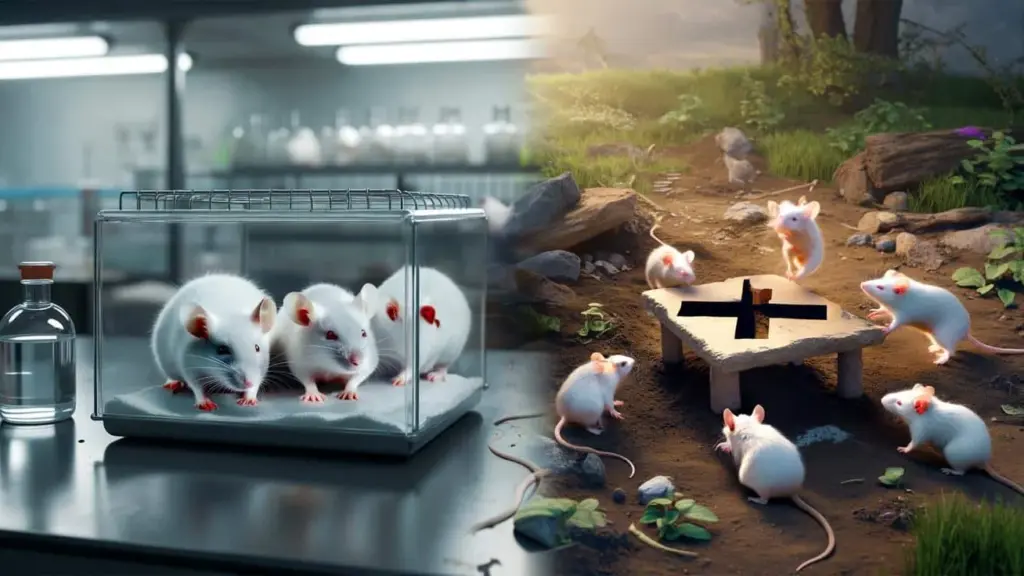
A team at Cornell University decided to test what happens when that environment changes. They took mice from a common inbred strain widely used in research and moved them into large outdoor enclosures for a week.
These enclosures were not wild countryside, but they were far closer to real life than a cage. The animals encountered soil, plants, changing weather, sunlight, shifting smells, natural sounds and more complex social encounters.
Just seven days in a richer, more natural space were enough to reshape how the mice responded to fear and risk.
In this setting, the mice could dig, build nests and roam. They faced new stimuli and mild, everyday challenges, like temperature swings and unfamiliar noises. The goal was not to rewild them completely but to give them an environment that looked more like the one their species evolved in.
The elevated plus maze under scrutiny
To measure anxiety, the researchers relied on a classic behavioural tool: the elevated plus maze. This is a raised cross-shaped platform with two open arms and two closed arms with walls. The idea is simple: open arms feel exposed and risky; closed arms feel safer.
In standard lab tests, anxious mice tend to hug the closed arms. Less anxious mice venture into the open arms more often and for longer periods.
The Cornell team ran two groups through this maze:
➡️ Pasta Cooked In The Sauce Is Revolutionising Weeknight Dinners And Halving Prep Time
➡️ Heizlüfter als falsche rettung für arme mietende im winter
➡️ Immer mehr ungeimpfte kinder im wartezimmer
➡️ Motten loswerden mit einem geruch, der mehr über deine nachbarn verrät, als dir lieb ist
➡️ Rentner muss für wiese vom imker landwirtschaftssteuer zahlen
➡️ Wölfe im land fluch für bauern segen für naturschützer
➡️ China Unearths 2,200-year-old Imperial Road That Challenges Our Modern Highways
➡️ Gemüse im vorgarten warum eine familie räumen soll und der ort gespalten ist
- mice kept only in standard lab cages
- mice given a week in the semi-natural outdoor enclosures
Before any mouse went outside, both groups behaved as textbooks predict: they avoided the open arms, froze often and spent most of their time in the sheltered sections. Anxiety, as measured by this test, looked high and stable.
Then came the surprise. After a week outdoors, the same strain of mice behaved differently. They were more willing to explore the open arms, showed fewer freezing episodes and moved around more.
The same genetic line, the same maze, the same test — but a new environment turned “anxious” mice into risk-takers in days.
Automatic tracking systems logged the animals’ movements second by second. This reduced the chance that human expectations or bias could explain the shift. The behavioural pattern itself had changed.
A behavioural reset in just one week
One of the striking points from the study is how quickly behaviour adapted. A single week outside the cage cut anxiety scores in a way that many drug trials would envy.
This was not only true for mice tested for the first time. Animals that had already shown strong anxiety in earlier maze sessions also softened their fearful responses after their outdoor stay.
Researchers described this as a form of behavioural reset. Experiences in a more varied, challenging environment did not just prevent high anxiety from forming. They seemed able to unwind a pattern that had already been established.
At the same time, the mice did not become reckless. They still showed signs of vigilance, scanning their surroundings and reacting to potential threats. But their reactions were more fluid, less dominated by immobility and avoidance.
The study suggests that anxiety in mice is not a fixed trait but a moving target, shaped continually by context.
This level of plasticity often receives little attention in lab-based behavioural work, which tends to treat anxiety scores as stable baseline characteristics rather than states that can be quickly moulded by experience.
When the cage becomes a hidden variable
Lab mice sit at the heart of biomedicine. Roughly three in four animals used in the field are mice, and they underpin research into everything from antidepressants to dementia.
The new data shows that the supposedly “neutral” cage environment is anything but neutral. By stripping away natural complexity, standard housing may be pushing behaviour into an artificial corner — one that looks nothing like what these animals, or humans, experience outside the lab.
This has consequences for how scientists interpret results. If anxiety scores change dramatically with housing conditions, comparing one study to another becomes riskier, especially when facilities use slightly different setups, noise levels or enrichment.
| Condition | Typical mouse behaviour | Implication for research |
|---|---|---|
| Standard cage | High avoidance, frequent freezing, limited exploration | Anxiety may be inflated by monotony and lack of stimulation |
| Semi-natural enclosure | More movement, risk-taking, flexible responses | Emotional states look more dynamic and context-dependent |
If the same genetic strain can switch profiles so quickly, can scientists still claim that they are measuring “innate” anxiety or a stable model of human disorders? The Cornell team argues that environment should be treated as a core experimental variable, not just background noise.
Ethics, welfare and scientific reliability
The findings touch directly on animal welfare debates. Many institutions already talk about “environmental enrichment” — adding tunnels, nesting material or toys to cages. But this new work suggests that enrichment is not just a kindness. It could change the scientific data itself.
Richer environments may produce animals whose brains and emotions are closer to those of wild counterparts and, by extension, closer to the complex realities of human life. On the other hand, richer environments are harder to standardise across labs, potentially adding variability that funders and regulators dislike.
Better welfare might mean better science, but it also means giving up the comforting illusion of perfect control.
The study also raises questions about how far animal models can stand in for human psychiatric conditions. If a mouse’s anxiety score swings dramatically with housing, how confidently can researchers use those scores to screen drugs for human anxiety or PTSD?
What this means for future experiments
Several practical shifts are already being discussed in the research community:
- including detailed housing descriptions in every behavioural paper
- testing animals in multiple environments, not just one maze in one room
- developing new behavioural tasks that mirror real-life challenges more closely
- treating environmental conditions as a variable to be studied, not just controlled
There is also growing interest in “naturalistic neuroscience” — experiments that mix modern tracking and brain-recording tools with more realistic surroundings. Outdoor enclosures, large indoor arenas with complex layouts, and variable lighting or soundscapes all form part of that shift.
Key concepts behind the experiment
This study leans on a few ideas that are worth unpacking:
- Behavioural plasticity: the ability of an animal to change its behaviour quickly in response to new experiences or environments. The mice’s anxiety reset is a striking case.
- Naturalistic setting: an experimental environment that includes features of the animal’s typical habitat — soil, variation, unpredictability — rather than a bare, standardised box.
- Model validity: the degree to which an animal model truly reflects the human condition it is meant to represent. If housing heavily shapes behaviour, that validity needs constant rechecking.
From mice to mental health
For readers thinking about human stress and anxiety, the parallels are hard to ignore. Humans also show strong behavioural plasticity. A week on holiday, a move from a cramped flat to green space or a shift from isolation to a busy social life can change how a person reacts to everyday threats.
The mouse data suggests that context and daily surroundings might influence emotional state as much as biology or medication. That does not make lab studies useless, but it suggests that therapies and policies targeting living conditions deserve more attention.
The way we house lab animals may be telling us as much about captivity as it does about disease.
Future work will likely test different durations outdoors, different strains of mice and other emotional states such as depression-like behaviour or social withdrawal. Some teams are also looking at brain changes, tracking how neural circuits remodel when animals step out of the cage and into a more complex, demanding environment.