
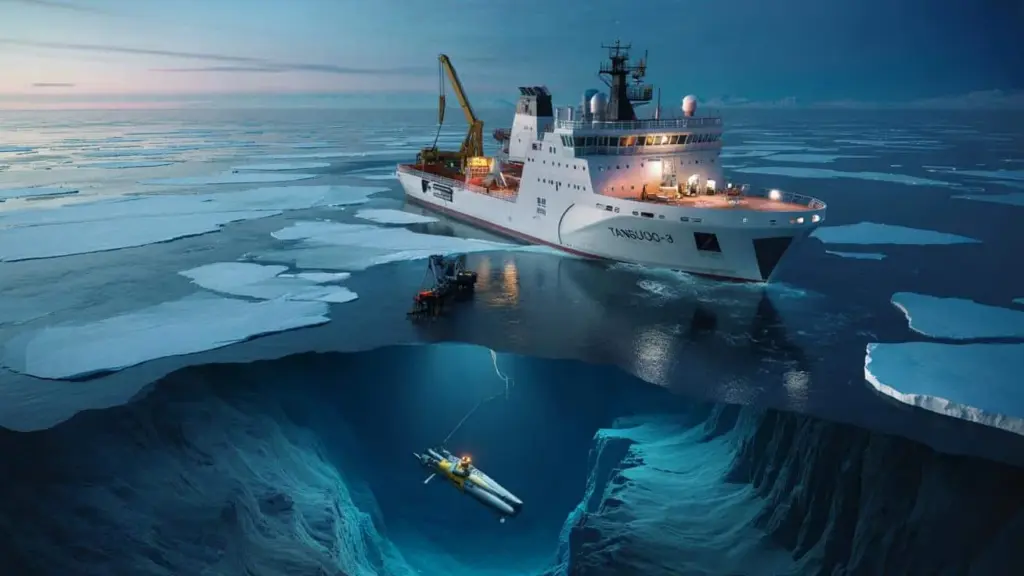
China’s latest deep-sea research ship is not just another piece of scientific hardware. It is a floating signal: that Beijing plans to push further into contested waters, polar routes and unexplored depths, using home-grown technology and long-term investment to stay there.
A ship built for the long game
The Tansuo-3 is the newest and most ambitious unit in China’s growing fleet of ocean research vessels. Officially, it is a scientific platform designed to study geology, marine ecosystems and extreme environments. Unofficially, it also serves as a tool of influence in an era where sea lanes and seabeds are increasingly political.
The ship did not appear out of nowhere. Since the late 2010s, Beijing has poured money into ocean science, new shipyards and polar logistics. In 2018, China went as far as branding itself a “near-Arctic state”, laying the narrative groundwork for a stronger presence in northern waters and launching a so‑called Polar Silk Road to link trade, science and strategy across new maritime corridors.
Deep-sea ambitions have moved in parallel. Chinese research programmes have openly targeted areas such as the Manila Trench, dropping instruments several kilometres below the surface. Each mission adds technical experience and data, but also reinforces a message: China intends to be a permanent player in the global race for seabed knowledge and resources.
The Tansuo-3 is less a one-off prestige project than the visible tip of a carefully assembled maritime strategy.
Behind the scenes, public institutes, state-owned shipyards and technology firms have formed a tight ecosystem. Earlier ice-capable research ships such as Xuelong and Jidi laid the foundations. Tansuo-3 now pushes that model much further, both in range and in sophistication.
A floating laboratory with polar teeth
On paper, Tansuo-3’s basic stats already stand out. The ship measures around 104 metres in length and displaces about 10,000 tonnes. Its tanks and storage allow it to travel close to 28,000 kilometres without refuelling, enough for long missions in remote regions. Top speed reaches roughly 30 km/h, and up to 80 people can live and work on board for weeks.
At the centre of the vessel lies one of its most distinctive features: a large “moon pool”, an opening straight through the hull into the sea below, measuring approximately 6 by 4.8 metres.
The moon pool lets crews launch and recover submersibles or equipment in rough seas, without exposing teams to breaking waves on the open deck.
➡️ Warum 10000 schritte am tag überschätzt sind diese einfache übung bringt schneller bessere ergebnisse und spaltet die fitnesswelt
➡️ Why Norwegians Never Help Garden Birds Like We Do (And Why They’re Probably Right)
➡️ Schule der selektion wie ein direktor seine schüler in gewinner und verlierer teilt
➡️ Die kernfusion rückt näher iter im süden frankreichs setzt das vakuummodul nummer fünf ein eine geschichte die die meinungen spaltet
➡️ Rentner soll für verpachtetes land steuern zahlen und entfacht einen heftigen streit zwischen imkern, finanzamt und nachbarn
➡️ Gendersprache im klassenzimmer zerreißt eine kleinstadt
➡️ Heizen für die tonne der häufigste fensterfehler frisst eure euros „fenster kippen ist kein lüften“ sagen experten doch millionen machen weiter und treiben die preise hoch eine debatte die familien spaltet
➡️ Menschen mit tiefem selbstwert verraten sich durch diese kleinen aber klaren zeichen laut psychologie
Tansuo-3 was built at the Guangzhou shipyard and began sea trials in October 2024. It carries advanced sonar systems designed in China, along with heavy-duty cranes and deployment rigs for crewed submersibles such as the Fendouzhe, a deep-diving vessel capable of reaching the hadal zone.
Unlike many traditional research ships, Tansuo-3 also comes with serious ice-handling capabilities. Its bidirectional icebreaking design allows the hull to move both forwards and backwards while crushing sea ice, giving it more flexibility in polar conditions and reducing the risk of getting trapped.
A multi-mission platform
The vessel is operated by the Deep Sea Science and Engineering Institute in Sanya, part of the Chinese Academy of Sciences. Official briefs highlight a wide range of roles:
- Geological surveys of ocean crust and tectonic zones
- Sampling of deep-sea sediments and mineral-rich nodules
- Underwater archaeology on wrecks and submerged heritage sites
- Long-term environmental monitoring, including pollution and climate data
- Biological studies of organisms living in high-pressure, low-light ecosystems
This versatility makes Tansuo-3 more than a niche scientific tool. It is effectively a mobile base, able to support operations in international waters, away from Chinese shores and existing infrastructure.
Science as soft power, and a source of tension
Beijing repeatedly stresses cooperation, open data and sustainability in its messaging around ocean missions. Chinese officials highlight joint expeditions and shared projects with foreign universities as proof that these ships serve global science first and national ambition second.
The picture looks different from Washington, Brussels or Tokyo. In 2025, Tansuo-3 reportedly took part in a 98‑day mission in the Arctic, deploying submersibles under ice and operating in waters that are increasingly viewed as militarily sensitive. Western analysts saw the voyage as a practical rehearsal for sustained Chinese activity in the high north, where melting ice is unlocking new shipping routes and possible resource fields.
Every scientific cruise generates datasets, but also nautical experience, under-ice navigation know‑how and logistics playbooks that can be reused for other purposes.
Experts quoted by regional outlets argue that research expeditions can double as large-scale exercises in supply, communications and emergency response. All those skills are useful for both civilian and strategic operations. Officially, China sticks closely to international maritime law and the United Nations Convention on the Law of the Sea. Yet the dual-use potential of ocean research – sensors, mapping, underwater robotics – fuels suspicion.
Why deep oceans matter so much
For the general public, deep-sea missions might sound like a niche scientific curiosity. For governments, they are about three intertwined issues: raw materials, climate and control of information.
| Domain | What’s at stake |
|---|---|
| Minerals | Polymetallic nodules and crusts contain cobalt, nickel, rare earths and other metals used in batteries and electronics. |
| Climate | Deep currents and carbon storage in the oceans shape global weather patterns and long-term warming. |
| Security | Seafloor maps, acoustic profiles and cable routes are valuable for navies and intelligence agencies. |
Ships like Tansuo-3 can chart underwater mountains, trenches and plate boundaries with high precision. They can also locate habitats that may be vulnerable to future mining, or conversely, targets for extraction once regulations allow it. That combination of knowledge and access is seen as a strategic edge.
How Tansuo-3 could change the balance at sea
Several scenarios are now exercising the minds of diplomats and defence planners. One is the Arctic. As sea ice retreats, seasonal shipping along the northern coasts of Russia and Canada could shorten Asia–Europe journeys by thousands of kilometres. A vessel that can both break ice and support deep research has obvious value for a country looking to shape new norms along such routes.
Another theatre is the western Pacific, including zones where exclusive economic claims overlap. Mapping trenches like the Manila Trench, or surveying seabed features near disputed islands, carries political weight. Having a modern, independent platform means Beijing does not need to rely on foreign ships or data in these sensitive waters.
At the same time, China’s capacity to conduct underwater archaeology is likely to grow. Wrecks can bolster territorial narratives, especially when they relate to historical trade routes or earlier naval activity. A sophisticated vessel able to document and recover artefacts lends extra force to those claims.
Key terms and concepts
Several technical expressions keep appearing around Tansuo-3 and similar projects. A quick breakdown helps clarify the stakes:
- Moon pool: A vertical shaft open to the sea inside a ship’s hull. It shields operations from waves, making launches safer.
- Hadal zone: The deepest part of the ocean, usually below 6,000 metres, found in trenches. Pressures here can exceed 1,000 times atmospheric pressure.
- Exclusive economic zone (EEZ): A belt of sea up to 200 nautical miles from a state’s coast where that state has special rights to resources, but not full sovereignty.
- Polymetallic nodules: Pebble-like mineral lumps lying on the seabed, rich in metals used for green technologies.
Risks, benefits and what comes next
Ocean scientists see clear benefits in a ship like Tansuo-3. More data on deep currents, chemistry and biodiversity can refine climate models. Improved imaging of the seabed can help identify geological hazards such as submarine landslides, which can trigger tsunamis. Intensified monitoring in polar regions makes it easier to track rapid changes in sea ice and ecosystems.
At the same time, the vessel illustrates unresolved tensions around deep-sea mining and environmental damage. Better access makes extraction more realistic, from manganese nodules to cobalt-rich crusts. But the ecological impact of disturbing these habitats is poorly understood. There is a risk that a technological lead in deep operations could tempt early moves before international rules catch up.
China is not alone in pushing into the abyss. The United States, European countries, Russia, Japan and others are all upgrading their research fleets and submersibles. Yet Tansuo-3 shows how quickly Beijing has moved from catching up to setting its own pace, knitting scientific ambition together with long-range polar and deep-ocean capability.
For coastal communities, activists and policy-makers, the next decade will likely involve a sharper debate over who controls access to the seabed, how data from these missions is shared, and what limits need to be placed on industrial use of the deep ocean. In that conversation, a 104‑metre Chinese research ship, equipped for ice and abyss alike, will loom large.