
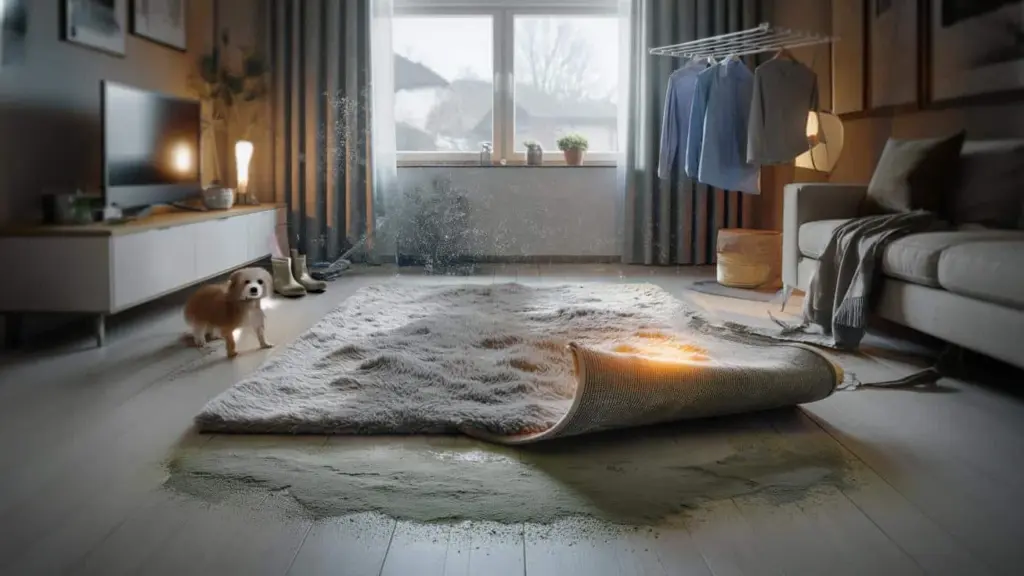
Yet one everyday object quietly thrives in this trapped, moist air.
While we scrutinise bathroom grout and cold bedroom walls for black spots, the real moisture magnet often sits right under our feet. That soft, stylish piece of décor can quietly hoard water, dust and allergens all season long, then release them into the air with every step.
The hidden culprit under your feet
The main driver of winter damp and indoor mould in many homes is not the window frame or the shower seal. It is the humble rug or carpet, especially thick living-room rugs and bedside runners.
By design, a rug holds on to particles. It traps crumbs, pet hair and dust. More importantly, its fibres absorb humidity from the air and from shoes, socks and spills. In winter, the problem worsens: we walk in with wet soles and muddy boots, the heating is on, and the ventilation is poor because windows stay shut.
Rugs act like giant sponges: they soak up moisture, store it deep in their fibres, and create the perfect base for mould to grow.
The dangerous part is that this contamination often stays invisible. While mould on a wall usually shows as black or green patches, a rug can look perfectly fine on the surface while colonies of fungi flourish at the base of the pile. Each time someone walks across it, microscopic spores are launched into the air.
Those spores are easily inhaled. In sensitive people, they can trigger coughing, wheezing, eye irritation and asthma attacks. Children playing on the floor are particularly exposed, as their faces are closer to the source and they tend to stir up dust as they move around.
Why cosy fibres love water so much
Not all floor coverings behave the same. The most desirable materials for comfort and style often turn out to be the trickiest in a damp environment.
Natural fibres: luxurious but thirsty
Wool, cotton and other natural fibres are prized for their softness and thermal comfort. They are also hygroscopic, meaning they attract and hold water molecules from the surrounding air without needing a visible spill.
Tests show that some of these textiles can retain up to four times their own weight in water before they even feel wet to the touch. That means a rug can be fully saturated deep inside while its surface seems normal.
➡️ Heizungsmythos entlarvt warum millionen deutsche mit ineffizienten kesseln geld verbrennen und es nicht wahrhaben wollen
➡️ Ein seltsamer Kartonwürfel landet im Briefkasten: Dafür ist er da
➡️ Ein Paar beschreibt, wie sie mit Essig Duschköpfe entkalken und für sauberes Wasser sorgen
➡️ Schlechte nachrichten für den nachbarn der seine einfahrt für den lieferdienst freihält warum ausgerechnet die scheinbar praktische wohltat für den onlinehandel zur nervenprobe für die ganze straße wird und eine geschichte erzählt die die meinungen spaltet
➡️ Immer mehr ungeimpfte kinder im wartezimmer
➡️ Ein Glas Reis im Schrank verändert das Raumklima und zieht unbemerkt schlechte Gerüche an
➡️ Heizung diese temperatur entscheidet ob sich diesen winter der schimmel in ihrer wohnung ausbreitet oder nicht
➡️ Die überraschende Korrelation zwischen finanziellem Erfolg und diesen 5 täglichen Gewohnheiten reicher Menschen
A rug may feel dry under your hand while the lower fibres remain damp for days, locked away from direct heat and light.
That is precisely where mould thrives: in dark, poorly ventilated layers that stay humid for more than 24–48 hours. Long-pile and shag rugs are the worst candidates because they imprison a pocket of moist air near the backing fabric, creating a tiny “tropical” microclimate on your floor.
Winter conditions stack the odds
Several seasonal factors add up:
- Less natural ventilation because windows are rarely opened.
- Temperature differences between warm air and cooler floors, creating condensation.
- Wet shoes, umbrellas and pet paws crossing the same rug every day.
- Indoor drying of laundry, raising the overall humidity level.
Each of these by itself might be manageable. Combined, they leave rugs almost permanently damp in some homes, especially in small flats or poorly insulated buildings.
The simple weekly ritual that keeps mould at bay
The good news is you do not need to get rid of your rugs to improve indoor air quality. A straightforward cleaning and airing routine reduces the risk dramatically.
Practical care routine for winter
Think of your rug as a washable textile that just happens to live on the floor. Here is a basic winter schedule that suits most households:
| Action | Frequency | Why it helps |
|---|---|---|
| Vacuum slowly, in both directions | Twice a week | Removes dust and organic debris that feed mould. |
| Spot-dry any wet area | Immediately | Prevents water from seeping deep into the backing. |
| Machine-wash small rugs (if label allows) | About once a month | Flushes out spores, bacteria and embedded dirt. |
| Air out the room with windows fully open | At least 10 minutes daily | Lowers indoor humidity and improves air renewal. |
Regular mechanical action — vacuuming and washing — is more effective against mould risk than occasional, aggressive “deep cleans”.
For stains or small wet patches, blot with an absorbent towel, then use a hairdryer set to warm (not hot) at a distance, moving constantly to avoid damaging the fibres. When possible, lift the rug and lean it on a chair or radiator rail so air can circulate underneath.
Managing the room, not just the rug
Rug care alone will not solve a chronically damp flat. The surrounding environment decides how quickly your textiles dry and how easily mould can settle.
Reduce moisture sources indoors
Day-to-day habits make a big difference. Some simple changes:
- Use the kitchen extractor hood when boiling, frying or simmering food.
- Close kitchen and bathroom doors while cooking or showering, then ventilate those rooms directly.
- Avoid drying laundry in the same room as your thickest rugs or carpets.
- Check air vents and trickle ventilators on windows are not blocked by dust or furniture.
If condensation forms regularly on windows or cold walls, a basic hygrometer can help you monitor humidity. Indoor relative humidity between roughly 40% and 60% is generally considered comfortable for most people and less favourable to mould growth.
When your rug becomes a health issue
For some households, rugs are not just a cleaning problem but a medical one. People with asthma, allergies, chronic sinusitis or weakened immune systems are particularly sensitive to airborne mould spores and dust-mite droppings that accumulate in textiles.
If someone in the home has unexplained coughs, stuffy nose or itchy eyes that get worse at night or in winter, the rug may be part of the puzzle.
In such cases, doctors and allergy specialists often suggest limiting thick carpets and opting for bare floors or low-pile, washable rugs instead. Synthetic fibres that dry quickly can be a safer compromise than heavy wool in poorly ventilated rooms.
Understanding a few key terms
The word “hygroscopic” regularly appears in discussions about damp. It simply means a material that naturally attracts and holds water from the air. Salt, sugar and some fabrics behave this way. A hygroscopic rug will absorb humidity even if you never spill anything on it.
“Spores” are the tiny reproductive units that mould releases into the air. They are too small to see individually, but once they land on a damp, nutrient-rich surface — like the underside of a rug loaded with dust — they can grow into visible colonies.
What happens if you ignore the problem
Imagine a typical flat with a large, fluffy living-room rug. The windows stay closed for weeks. Laundry dries on a rack nearby, and a dog comes back from rainy walks straight across the fibres.
At first, nothing looks wrong. After a couple of months, a faint musty smell appears, especially when the heating switches on. One child begins to cough more at night. The owner cleans the walls, changes the curtains, but never thinks of lifting the rug. Underneath, the backing is spotted with grey patches and the underlay feels slightly damp.
This scenario is common. The rug turns from a cosy design feature into a slow, constant source of indoor pollution. Yet a few minutes of extra care each week — vacuuming, airing and fast drying — would have stopped that build-up long before it became a problem.
Rugs still have plenty of advantages in winter: they cut the shock of cold floors, reduce noise, and make a room feel welcoming. The trick is to treat them as living materials that interact with moisture and air, not as static décor. With that mindset, you keep the comfort and colour, but lose the hidden mould farm that too often comes with them.