
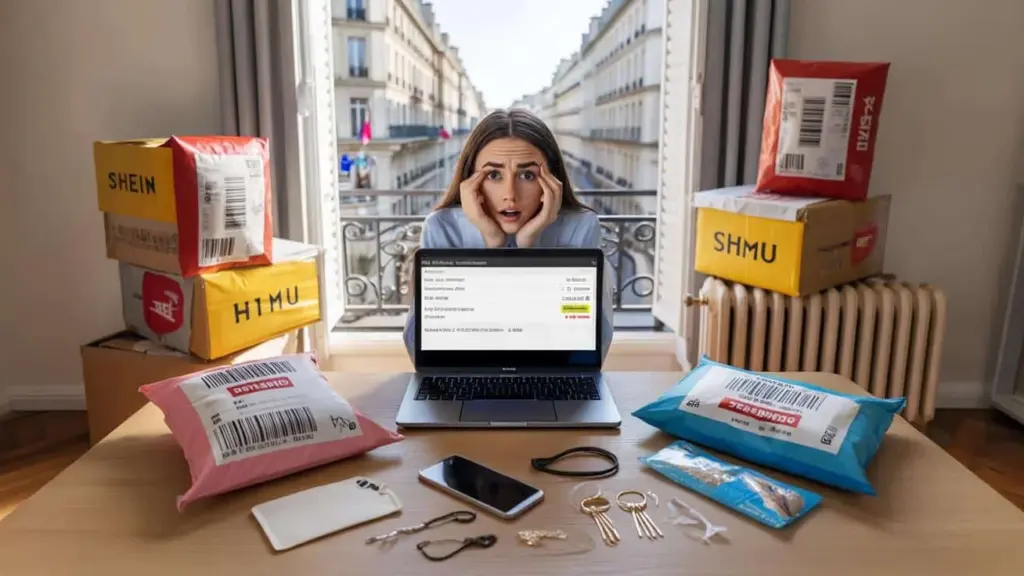
France has just rewritten the rules for ultra-low-cost imports from platforms like Shein, Temu and AliExpress, and the move could signal a broader European shift. A tiny extra charge on every small parcel may sound harmless, yet it directly targets the core business model of these shopping apps: ultra-cheap items, shipped one by one, from warehouses thousands of miles away.
A flat €2 tax that hits nearly every “cheap haul”
The French National Assembly has approved a new tax aimed squarely at low-value imports from outside the European Union. The rule is very simple: a fixed fee of €2 applies to every parcel worth under €150 that comes from a non‑EU country, including China.
Any Shein, Temu or AliExpress parcel under €150, shipped from outside the EU to France, now carries an automatic €2 surcharge.
Orders shipped from France or another EU member state are not affected. The measure is designed to plug a gap in the rules that had allowed millions of low-value parcels to slip through with little tax and minimal checks.
The government’s official line is threefold. This new charge is meant to:
- Fund tighter customs controls on the huge volume of small parcels arriving daily
- Clamp down on unfair competition faced by local shops and European e‑commerce sites
- Improve VAT collection on imported goods
In practice, the tax will appear at checkout as an additional cost. Platforms are not legally forced to list it transparently, but they have every incentive to pass it on directly to French customers rather than absorb it into their own margins.
From €1 trinkets to 20% price jumps
For occasional buyers, €2 may look like a minor detail. For regular fans of flash sales and “hauls”, the effect is much sharper. Shein’s average basket in France sits around €50, and the typical price per item hovers near €9. Many users place small, frequent orders worth €5, €10 or €15.
On a €10 order, that flat €2 tax represents a 20% price increase. For a €20 basket, it is 10%. Only once you approach the €150 threshold does the extra cost become relatively small.
The smaller the order, the heavier the impact: a single cheap T‑shirt now carries the same €2 charge as a bulging parcel full of clothes.
➡️ Living in this French city in 2030 could be far harder than you think: start planning your move
➡️ Your TV’s USB port isn’t useless: 4 smart ways to actually use it
This could fundamentally change how people use these apps. Instead of splitting purchases into several tiny orders to snatch free shipping or extra coupons, shoppers in France now have a clear financial reason to group items together and place fewer, larger orders.
How the €2 charge changes real bills
| Order value | Old total (before tax) | New total (with €2 tax) | Effective increase |
|---|---|---|---|
| €8 | €8 | €10 | +25% |
| €15 | €15 | €17 | +13.3% |
| €50 | €50 | €52 | +4% |
| €140 | €140 | €142 | +1.4% |
For low-income shoppers who leaned on these platforms as a budget lifeline, that shift will feel very concrete. The law effectively ends the era of “almost tax-free” €3 gadgets and €5 dresses arriving one by one from Shenzhen.
Why France is targeting Shein, Temu and AliExpress now
The tax is not arriving in a vacuum. In France, Chinese e‑commerce players have faced growing criticism from politicians, retailers and environmental groups. Every day, tens of thousands of small parcels land in the country, often with products of low unit value and short lifespan.
French retailers argue this flood of ultracheap goods undercuts shops that pay European wages, rents and taxes. For the first time, several major retail chains have joined forces to file a joint complaint against Shein for alleged unfair competition.
Big-name French retailers, usually rivals, have aligned on one point: ultra-low-cost Chinese platforms distort competition.
Alongside economic concerns comes the environmental angle. Each small parcel requires packaging, storage and international transport, usually by air or fast freight. Policymakers are increasingly uncomfortable with shoppers ordering a handful of hair clips or a single phone case from the other side of the planet, wrapped in layers of plastic, for just a few euros.
Platforms under pressure to rethink their model
The new French tax will not bankrupt Shein or Temu, but it pokes directly at their core promise of “almost free” shipping and microscopic prices. To remain attractive, these companies have a few options.
- Absorb part of the €2 fee themselves, cutting into their margins
- Raise product prices slightly while calling shipping “free”
- Encourage customers to build larger baskets to dilute the tax
- Develop more local or European warehouses to avoid the extra charge
Shein has already tested a different path in France: moving into physical retail. The brand briefly set up in the famous BHV department store in Paris. The experiment went badly. Customers found the prices in-store far less attractive than online, several established brands in the same building pulled out in protest, and Shein’s public image took another hit. BHV has since delayed plans to roll out Shein corners in other French cities.
That failed launch underlined a harsh reality for ultra-low-cost platforms: thriving online with tax advantages and cheap shipping from Asia does not automatically translate into success on European high streets.
What this means for shoppers across Europe
For now, the €2 tax only targets parcels entering France, but other EU countries are watching closely. Brussels has already scrapped a previous exemption that allowed goods under €22 to be imported into the EU without VAT. France’s move is a stronger national layer on top of those changes.
If the measure proves popular with domestic retailers and does not provoke a major consumer backlash, similar schemes could appear elsewhere. The logic is straightforward: tax the flood of low-value imports, fund more checks at the border, and level the playing field for local businesses.
How to adapt your online shopping habits
For people in France who still want to keep using Chinese platforms, there are a few practical ways to soften the blow:
- Group purchases with friends or family to share the €2 charge across a larger basket
- Avoid micro-orders: a single €4 item now costs at least €6 with the levy
- Compare with EU-based marketplaces that may have slightly higher base prices but no per‑parcel tax
- Pay attention at checkout: platforms may present the fee under vague labels like “handling” or “import service”
Some users might also reassess what counts as a “good deal”. When the real cost of an impulse purchase rises, the value of waiting, buying second-hand or choosing a local retailer can suddenly look different.
Key concepts behind the new charges
A few terms sit behind this tax and often cause confusion:
- Value-added tax (VAT): A consumption tax applied in EU countries. Many low-value imports used to slip through without proper VAT collection, particularly when sellers undervalued packages.
- Customs controls: Checks carried out at the border to verify declared value, safety standards, counterfeiting risks and tax. The €2 levy is partly intended to finance more of these inspections.
- Unfair competition: When companies selling into a country avoid costs—tax, labour, environmental rules—that local firms must bear. Politicians argue this is exactly what has been happening with mass imports from some platforms.
Imagine a student in Lyon ordering a €6 phone case and a €3 pair of earrings from Temu. Before the change, the full bill might stay under €10, shipping included. With the new tax, the same order climbs to €11. That is not catastrophic for one purchase, but repeat the pattern monthly and the annual cost difference becomes visible.
The real test will come over the next year. If shoppers change habits, placing fewer but larger orders or switching to EU-based sellers, regulators across Europe will see this French experiment as a template. If users simply absorb the extra €2 and keep buying at the same rhythm, platforms may barely flinch. Either way, the era of ultra-cheap, barely taxed parcels from Shein, Temu and AliExpress landing on French doorsteps has met its first serious barrier.