
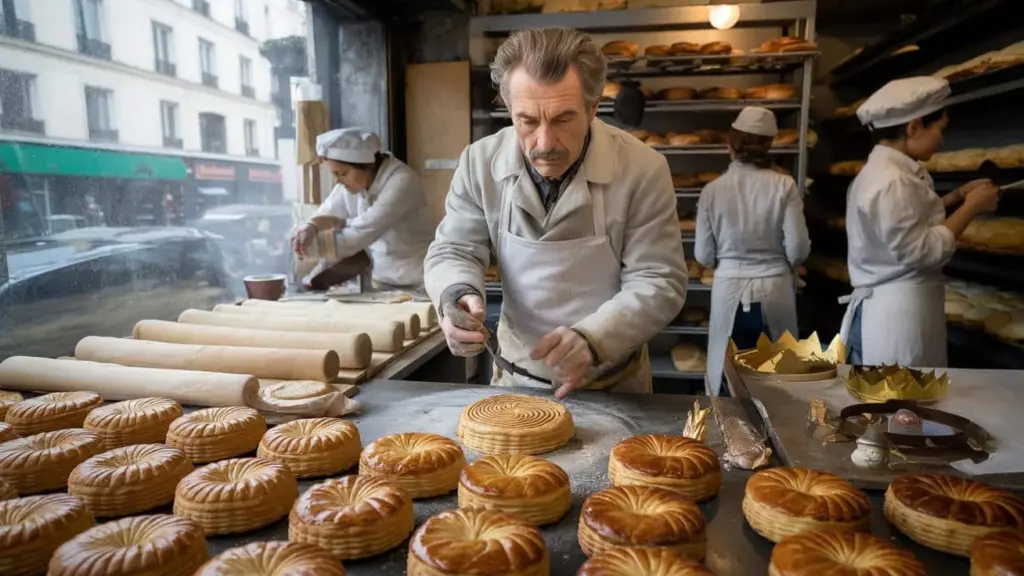
Behind the window of a modest shop in south Paris, a team of bakers is preparing to bake 15,000 galettes des rois in just two months, without sacrificing a single crumb of quality. At the centre of this challenge: Lionel Bonnamy, crowned twice with the title of “Best Galette des Rois in Greater Paris”, who treats each Epiphany season like a sporting competition.
From neighbourhood bakery to reference for the best galette
The scene is set in the 14th arrondissement of Paris, at La Fabrique aux Gourmandises. On paper, it is a classic artisan boulangerie-pâtisserie. In reality, this is where one of France’s most followed Epiphany stories is unfolding.
In 2021, then again in 2025, Bonnamy won the highly watched contest for the best galette des rois in Greater Paris. The double win turned his galette into a minor phenomenon. Lines now snake out of the shop in January, and some customers cross the city – or further – for a single slice of frangipane-filled pastry.
Winning twice did not turn the bakery into a luxury brand. The stated goal is quality at a fair price, not speculation.
Far from capitalising with inflated prices, the baker insists his galettes must remain accessible: roughly 10 euros for two people, around 40 euros for ten. The recognition has strengthened his reputation, even earning him orders for Matignon, the French prime minister’s residence, at the start of 2026.
“I’m aiming for 15,000 galettes”: a crazy but calculated target
For the 2025–2026 Epiphany season, Bonnamy has set himself a staggering goal: 15,000 galettes in two months. For a single neighbourhood shop, that number is anything but anecdotal.
Epiphany is simply the most intense time of the year for La Fabrique aux Gourmandises. The galette des rois, crowned with a paper crown and hiding a fève (little charm) inside, now brings in around 20% of the bakery’s annual turnover – more than Christmas itself.
The pace is brutal. Between 29 and 30 December, the team aims to produce around 2,000 galettes as a launchpad. The shop then closes on 1 January to let staff recover, before the real sprint: the first Epiphany weekend, when they produce roughly 3,000 galettes alone.
The whole season hangs on a single weekend: if the bakery keeps up then, the 15,000-galette target suddenly looks realistic.
➡️ Warum Joghurtbecher wirklich nicht ausgewaschen werden müssen und welche anderen Mythen im Müll-Guide 2025 falsch sind
➡️ Wie ein übergewichtiger büroangestellter mit einem billigen trick in drei wochen zehn kilo verliert und damit zeigt wie bequem und selbstbetrügerisch seine kollegen wirklich sind
➡️ At What Temperature Should Oysters Be Kept To Avoid Food Poisoning?
➡️ Product recall at Leclerc, Intermarché, Système U and others over contaminated black pudding
➡️ In dieser deutschen Stadt durchsuchen Mitarbeiter die Mülltonnen und leeren sie nicht mehr, wenn der Müll falsch getrennt wurde
➡️ Psychologie enthüllt: diese unscheinbaren zeichen verraten deinen tiefen selbstwert
➡️ Birth of a new European energy giant under French control after this €5.1 billion takeover by TotalEnergies
➡️ Die überraschende Verbindung zwischen Bildungsniveau und politischer Teilnahme in verschiedenen Gemeinden
Military-style organisation behind the counter
Inside the bakery, nothing is left to chance. Each galette passes through five to six pairs of hands before reaching the display. The team rotates through positions: rolling, garnishing, decorating, baking, finishing.
This rotation serves two purposes. It helps maintain concentration during long, repetitive shifts, and it reduces the risk of mistakes that can ruin the texture or appearance of a galette. In a period where the team sleeps little, mental freshness matters as much as technical skill.
Bonnamy uses a blunt personal test before any galette is allowed to be sold: “Would I pay this price for this galette myself?” If the answer is no, the piece is removed from circulation. That ruthless standard is part of what draws loyal customers back year after year.
Top-level ingredients, zero shortcuts
Technique is crucial, but the baker insists that ingredients lay the foundation. The shop works almost exclusively with premium raw materials, focusing on traceability and freshness.
- French butter with high fat content for flavour and flakiness
- Label Rouge flour from short supply chains
- Whole or crushed Spanish almonds, processed in Spain
- Natural vanilla, no artificial flavourings or colourings
For the frangipane – the iconic filling – this freshness is key. Almonds lose aroma with time, so using recently ground nuts brings more intense flavour and a better texture. The bakery also rejects preservatives and colourants, relying instead on technique and timing to keep products stable.
Fresh almonds, French butter and slow processes replace additives, giving the galette its generous flavour without artificial boosters.
From dough to crown: a meticulous process
The upside-down puff pastry that changes everything
Where many bakers use classic puff pastry, Bonnamy opts for what professionals call “inverted” puff pastry. In a traditional dough, butter is wrapped inside the detrempe (the base dough of flour and water) and folded repeatedly.
Here, it is the opposite: the butter is mixed with flour to create a buttery layer that surrounds the dough.
This method, similar to a “beurre manié” (a kneaded mix of flour and butter), brings more fondant, a deeper sense of indulgence and better keeping qualities. It is also more technically demanding, as the butter layer must stay at the perfect temperature to avoid leaks or breakage during folding.
Layering, resting, waiting
Once the dough is prepared, it needs to rest in the cold. Then comes a strict sequence of folds: one English turn, two double turns and one simple turn. Between each, the dough rests again, sometimes overnight.
These resting phases are not a luxury. They allow the gluten to relax and the butter to stabilise, which creates the signature flaky layers once the galette hits the oven. Only after this patient work is the dough rolled out and cut into discs, called abaisses, which will form the base and top of the galette.
The sacred stage: frangipane and fève
After shaping, the dough circles chill for about an hour. Then comes what the team sees as the sacred moment: filling with frangipane and adding the fève.
The frangipane is a mix of vanilla pastry cream and almond cream. It must be dense enough not to leak, but light enough not to crush the pastry. Too much moisture and the bottom goes soggy; too little and the galette feels dry.
Once filled, the baker seals the two discs, brushes the surface with an egg wash, chills the galette again, then brushes with another layer of egg wash before scoring the traditional decorative patterns on top.
The final golden swirl on top is not just decorative. It hints at the layers hidden beneath and the care invested in each step.
54 minutes in the oven that can change everything
Baking lasts at least 54 minutes. The goal is a deep, even colour and a crisp base, with fully cooked layers. At the end, the galette is brushed with a light syrup and returned briefly to the oven. The syrup adds shine and improves keeping qualities without turning the surface sticky.
After baking, the galette “sweats” on a rack. Excess moisture evaporates, ensuring the crust stays crisp once it reaches the customer. Only then does it travel to the front of the shop, ready to be chosen, carried home and sliced around a crowded table.
When and where to taste Paris’s 2025 champion galette
The bakery sells its galettes from 2 January to 15 February, giving Epiphany fans a long window to get their fix. There are no pre-orders: customers must show up in person at La Fabrique aux Gourmandises in the 14th arrondissement.
Sizes range from intimate to family feast, typically from two to ten people. The absence of reservations can mean queues, but also creates a sense of shared anticipation. Each day’s production is baked, cooled and sold in a steady flow.
| Size | Number of people | Approximate price |
|---|---|---|
| Small | 2 | ~ €10 |
| Large | 10 | ~ €40 |
Why the galette des rois still matters in 2025
For many French families, the galette des rois is more than a dessert. It marks the unofficial end of the festive season and carries traditions that blend religion, folklore and childhood memories.
Inside every galette sits a fève, originally a simple dried bean, now more often a small porcelain or ceramic figurine. Whoever finds it in their slice becomes “king” or “queen” for the day and wears the paper crown that comes with the cake.
The tradition reaches beyond France. In the UK or US, food lovers increasingly hunt down the galette in French bakeries or adapt the recipe at home. For those curious about trying it, the key elements are a flaky puff pastry, a rich almond-based filling and a long bake.
What home bakers can learn from a 15,000-galette season
Repeating the exact method of a Paris champion at home is unrealistic. Still, several principles translate well to a domestic kitchen.
- Plan ahead: prepare puff pastry and frangipane a day in advance to reduce stress.
- Use good butter: a higher-fat European-style butter gives better layers.
- Chill between steps: cold dough is easier to handle and rises more evenly.
- Bake longer than you think: underbaked galettes stay pale and soft underneath.
- Let it rest: a short cooling period on a rack keeps the bottom from turning soggy.
For anyone tempted to sell galettes or offer them in a café, the Bonnamy approach also highlights the risks: massive peaks in demand, long days, and the constant temptation to cut corners. His strategy shows that a clear quality rule – only sell what you’d pay for yourself – can protect a brand, even in the middle of a production storm.
The Epiphany rush at La Fabrique aux Gourmandises is a reminder that seasonal pastries can shape an entire business. A single product, mastered and repeated thousands of times, can turn a neighbourhood bakery into a winter destination and, for a few intense weeks, into something very close to a high-performance kitchen.